I just had an experience much like the experiences of those Adirondack locals who were left out of the equation while the discussions about the rules and regulations of the ADK Park at its beginnings were taking place. I live in a very rural place. There are horse farms and corn fields and essentially nothing else until the nearest town, which takes about 7 minutes to get to and STILL has about 5 antique stores for every restaurant. (I think there are 3 restaurants). I have no cell service in my house, and you have to walk about a mile and a half to the top of the road to be able to get anything remotely close to the amount of signal you'd need to make a phone call. I've lived in this place for 19 years (my entire life), as many of the Adirondack locals probably did as well. And, therefore, I've gone my whole life without ever having more than one bar of cell service in my house. This can be an inconvenience, but more than anything, it has created a community between my family, the families around us, and the entirety of the private boarding school campus on which I live. This includes my good friend Meg (who's in Janelle's section of this class with me!), who attended Millbrook for 4 years, and also had to deal with the inconvenience that comes from the lack of cell phone service.
This past week, Meg posted a blog post about the necessity of the installation of a cell phone tower near Millbrook's campus. She referred to the opinion of the students, herself included, regarding the isolation that comes from not being able to use your cell phone to call your friends back home, or you family. She then referred to the side opposed to the cell tower: the weekenders coming up from NYC, and looking for a relaxing, rural escape. I read the post and thought, "Wait, I don't fit into either of those groups." Yes, I was once a Millbrook student, but I am also a local resident of the area, and definitely not a weekender with a primary home in New York City. Both of these groups are outsiders (on a very extended vacation, for the boarding students), and although I'm sure this was just an oversight on Meg's part, it was still a disheartening feeling to be left out. I felt protective of my landscape and wanted to have my opinion against the cell tower heard and respected. I find this analogous to the conflict between inside and outside control of the Adirondack Park that we have talked about so much, and this feeling of not being included in my own area's decisions has made me understand why internal control, to some extent, is so important. For the residents of the park to abide by the rules and regulations religiously, they must also agree that said terms are appropriate and useful. They should be able to have their opinions about the land they reside in heard. This conflict, however, is not resolved because of the unbelievable amount of outsider control that led to the ultimate creation of the park. This instance (and it is a BIG instance) shows why outsider control, and a possibly less emotional connection with the land, can lead to more practical decisions. Without the outsider control preserving the land for business and industry purposes, the Adirondack Park would probably not exist, at least not to the extent that it does today. Essentially, we need a way for outsider control to contribute their unemotional opinion while still allowing the often less powerful insiders to be heard and respected.
PSA: Meg knows I fully respect her opinion and she approved this blog post being written!
Saturday, November 1, 2014

The Adirondack Powder Skiers Association and Possible Amendments to the SLMP
On the Adirondack Almanack today, I saw an article that interested me greatly. The Adirondack Powder Skiers association is pushing for an amendment to the Adirondack State Land Master Plan (SLMP) to allow for the maintenance of ski trails and glades on forever wild land. This could potentially be the first time the SLMP is amended in over 25 years.
First, some background information is necessary to understand the issue. Backcountry skiing has been a huge part of Adirondack culture since the 1930s, when the CCC program resulted in the cutting of many ski trails in the high peaks. Before ski lifts and developed areas became widespread, these trails were very popular. With the advent of ski lifts however, these trails were barely used and often neglected. The hiking trail up Wright Peak was actually relocated onto the bottom half of the ski trail, creating potential for dangerous collisions between hikers and skiers.
In the 1970s, backcountry skiing became popular once more due to the advent of the Ski to Die Club. These intrepid skiers made bold and harrowing descents all over the high peaks; Ron Konowitz, the club's founder, became the first and only skier to ski all 46 high peaks. Lately, backcountry skiing has seen an even larger resurgence due to increasingly lightweight equipment, and a public desire to escape the relative comfort and safety of developed ski areas. Every year the Mountaineer hosts the Adirondack backcountry ski festival, bringing professionals like Glenn Plake to the high peaks, and offering classes to educate the public. The Adirondack Powder Skiers association is looking to build on the recent momentum of backcountry skiing in the Adirondacks.
Anyone who hikes in the high peaks immediately notices all the brilliant, white and gray bedrock scars littering the steep mountainsides. These natural slides provide great natural ski trails; the caveat is that they not only require a high level of ski expertise, but also knowledge of how to safely travel in avalanche terrain, and strong wilderness skills. To those unprepared, a journey onto one of the slides could have perilous consequences. Aside from these slides, there are very few trails or "glades" designated for skiing in the high peaks. Konowitz, the founder of the Adirondack Powder Skier Association, is pushing for the right to maintain ski trails and glades on forever wild land by removing blowdown and trimming underbrush. He believes that this will give skiers a safer option in the Adirondack backcountry and keep them off hiking trails, which will prevent collisions between skiers and hikers on the narrow, winding paths.
On one hand, while Konowitz is pushing for minimal maintenance of ski trails, this could be another "foot-in-the-door" scenario. If the amendment to the SLMP is passed, will we eventually see huge, ugly swaths of clear-cut forests all for the sake of skiing? This occurred (illegally) a couple years ago on Big Jay Mountain in Vermont. Also, could this potential amendment of the SLMP set the stage for other, more drastic changes? On the other hand, Konowitz is a very experienced Adirondack traveller and wilderness advocate. Considering his skiing resumé, it is unlikely that he would ever approve of anything more than minimal maintenance. In addition to this, backcountry skiing is one of the least-impactful recreational activities on the Adirondack land because it is only practiced when the ground is protected by layers of snow. In my opinion, it is kind of ridiculous that minimal maintenance ski trails are prohibited, while hiking trails and even horse trails form a vast web all over the Adirondacks. Just like the rail-trail issues, public forums are being set up to discuss the potential changes.
If anyone is interested in reading about these issues, here are two good articles. (disclaimer: both the articles and my opinion are written from pro-skier stances.)
http://www.powder.com/stories/adirondack-amendment/
http://www.adirondackalmanack.com/2014/10/commentary-backcountry-skiers-seek-slmp-amendments.html
First, some background information is necessary to understand the issue. Backcountry skiing has been a huge part of Adirondack culture since the 1930s, when the CCC program resulted in the cutting of many ski trails in the high peaks. Before ski lifts and developed areas became widespread, these trails were very popular. With the advent of ski lifts however, these trails were barely used and often neglected. The hiking trail up Wright Peak was actually relocated onto the bottom half of the ski trail, creating potential for dangerous collisions between hikers and skiers.
In the 1970s, backcountry skiing became popular once more due to the advent of the Ski to Die Club. These intrepid skiers made bold and harrowing descents all over the high peaks; Ron Konowitz, the club's founder, became the first and only skier to ski all 46 high peaks. Lately, backcountry skiing has seen an even larger resurgence due to increasingly lightweight equipment, and a public desire to escape the relative comfort and safety of developed ski areas. Every year the Mountaineer hosts the Adirondack backcountry ski festival, bringing professionals like Glenn Plake to the high peaks, and offering classes to educate the public. The Adirondack Powder Skiers association is looking to build on the recent momentum of backcountry skiing in the Adirondacks.
Anyone who hikes in the high peaks immediately notices all the brilliant, white and gray bedrock scars littering the steep mountainsides. These natural slides provide great natural ski trails; the caveat is that they not only require a high level of ski expertise, but also knowledge of how to safely travel in avalanche terrain, and strong wilderness skills. To those unprepared, a journey onto one of the slides could have perilous consequences. Aside from these slides, there are very few trails or "glades" designated for skiing in the high peaks. Konowitz, the founder of the Adirondack Powder Skier Association, is pushing for the right to maintain ski trails and glades on forever wild land by removing blowdown and trimming underbrush. He believes that this will give skiers a safer option in the Adirondack backcountry and keep them off hiking trails, which will prevent collisions between skiers and hikers on the narrow, winding paths.
On one hand, while Konowitz is pushing for minimal maintenance of ski trails, this could be another "foot-in-the-door" scenario. If the amendment to the SLMP is passed, will we eventually see huge, ugly swaths of clear-cut forests all for the sake of skiing? This occurred (illegally) a couple years ago on Big Jay Mountain in Vermont. Also, could this potential amendment of the SLMP set the stage for other, more drastic changes? On the other hand, Konowitz is a very experienced Adirondack traveller and wilderness advocate. Considering his skiing resumé, it is unlikely that he would ever approve of anything more than minimal maintenance. In addition to this, backcountry skiing is one of the least-impactful recreational activities on the Adirondack land because it is only practiced when the ground is protected by layers of snow. In my opinion, it is kind of ridiculous that minimal maintenance ski trails are prohibited, while hiking trails and even horse trails form a vast web all over the Adirondacks. Just like the rail-trail issues, public forums are being set up to discuss the potential changes.
If anyone is interested in reading about these issues, here are two good articles. (disclaimer: both the articles and my opinion are written from pro-skier stances.)
http://www.powder.com/stories/adirondack-amendment/
http://www.adirondackalmanack.com/2014/10/commentary-backcountry-skiers-seek-slmp-amendments.html
Friday, October 31, 2014
Beavers are Gaining New Respect
I plan to do my final project on beavers and, thanks to Onno, I was directed to a NY times article on beavers that was published October 27, 2014. It's very interesting to think about the change in human opinion of beavers throughout history. In some of our earlier readings it was clear that the beaver was looked at as a pest that needed to be removed by humans. Also, beaver hats were so popular in England in the 15th century that beavers were extirpated from New York and almost the entire East cost by 1640. The beaver remained almost completely extirpated from the East cost till their reintroduction in the early 1900s to the Adirondacks and similar areas. What early settlers failed to realize is the essential role that beavers play in local ecosystems. Beavers are essential to raising the water table along creeks and streams, which allows trees and plants to grow on the banks which secures the soil and protects it from erosion. It is also very difficult to replicate a beaver dam. The Western US is starting to realize their need for beavers' complex dams, as the hydroelectric dams become a point of contention for environmentalists and power companies. Beaver dams provide an eco-friendly solution to the dam problem in the West, although it seems like common sense, it's taken engineers years to admit that the beaver is still the best dam solution. Not only are Beavers instinctually inclined to stop running water, their dams also require no burning of fossil fuels or poring of cement. It's very likely that beavers are the most sustainable solution to almost any problem that originates from low water tables.
The Forest Preserve Wasn't Enacted to Actually Preserve the Forest? What?
At the beginning of Scheinder's "Forever Wild" chapter, Schneider mentions two engravings depicting the Adirondacks that were published in the January 24, 1885 issue of Harper's magazine. There are two prints; One entitled, "A Feeder of the Hudson, as it was," and the other, "A Feeder of the Hudson, as it is." I did a little digging and found the prints that Schneider was referring to.
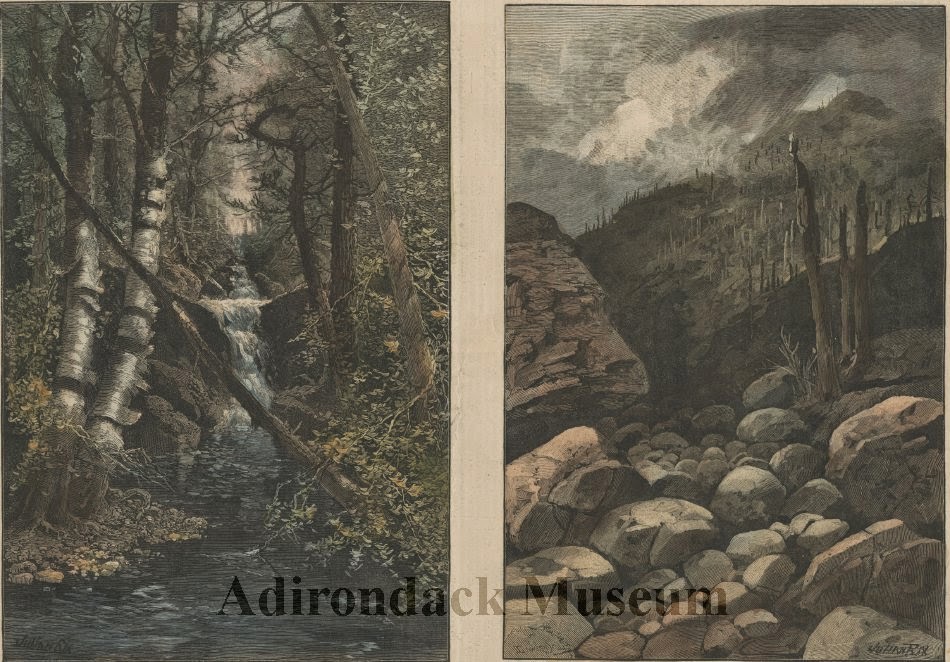 On the left is the first image, "A Feeder of the Hudson, as it was" and on the right is "A feeder of the Hudson, as it is." In these prints, by Julian Rix, we see two completely different landscapes. The first one shows a beautiful and lush landscape with moss covered rocks, a flowing waterfall, and towering trees. In the second image, we see a barren landscape with tree stumps, and even a smoldering one that appears to have been burned just moments before. These prints really capture the drastic change that occurred in the 19th century in the Adirondacks as logging became more and more prevalent.
I was very surprised when Schneider asserted that no one was concerned with preserving the "wilderness for its own sake," (220) but more so for more utilitarian and commercial purposes. Verplanck Colvin highlighted this commercial concern in his legislative report that "The Adirondack Wilderness contains the springs in which are the sources of our principal rivers, and the feeders of our canals. Each summer the water supply [...] has lessened, and commerce has suffered," (222). Even once the Forest Preserve was enacted, Schneider points out that there was no legislative protection for the trees of the Adirondacks. But Schneider isn't surprised as he reiterates that the "neither the Forest Preserve nor the Adirondack Park was created out of a desire to preserve wilderness in any prehumanized sense, " (224).
I had always assumed that the Adirondack Park and the Forest Preserve were made first and foremost out of a concern for the actual inhabitants and ecology of the area. Then again, the Adirondacks have a long history of economically driven movements. While it is difficult to understand this mindset from a contemporary framework, these legislations were beneficial to the Adirondacks, no matter what the original intent was in the 19th century.
I was very surprised when Schneider asserted that no one was concerned with preserving the "wilderness for its own sake," (220) but more so for more utilitarian and commercial purposes. Verplanck Colvin highlighted this commercial concern in his legislative report that "The Adirondack Wilderness contains the springs in which are the sources of our principal rivers, and the feeders of our canals. Each summer the water supply [...] has lessened, and commerce has suffered," (222). Even once the Forest Preserve was enacted, Schneider points out that there was no legislative protection for the trees of the Adirondacks. But Schneider isn't surprised as he reiterates that the "neither the Forest Preserve nor the Adirondack Park was created out of a desire to preserve wilderness in any prehumanized sense, " (224).
I had always assumed that the Adirondack Park and the Forest Preserve were made first and foremost out of a concern for the actual inhabitants and ecology of the area. Then again, the Adirondacks have a long history of economically driven movements. While it is difficult to understand this mindset from a contemporary framework, these legislations were beneficial to the Adirondacks, no matter what the original intent was in the 19th century.
Thursday, October 30, 2014
Cell Towers; a necessary eyesore
After discussing cell towers and reading the article that Janelle had sent to us
(http://www.adirondackalmanack.com/2014/10/feds-preserve-local-jurisdiction-over-cell-towers.html?utm_source=Adirondack+Explorer+%26+Adirondack+Almanack&utm_campaign=4fd31f5869-Adirondack_Almanack_RSS_EMAIL_CAMPAIGN&utm_medium=email&utm_term=0_b49eb0d11b-4fd31f5869-47298733)
I think I need to play devils advocate for a moment. Going to school at a pretty remote prep school I find a lot of parallels with the Adirondacks. Millbrook New York, acted as the weekend escape for many city dwellers who could afford to have a second home to ride horses and drink tea. This became a home to anyone looking for a rural retreat from "real life". Sound familiar? We also had the issue of putting in cell towers. While the family retreating for the weekend from these overused technologies could have cared less about having no signal on their phone all weekend (partly because it was just the weekend), as a student trapped with no contact outside of my school bubble I felt much differently. Having no signal on campus was inconvenient to say the least and at times a safety hazard. I can see why in both Millbrook and the Adirondacks people would fight to avoid the building of these "eyesores", but for people who live in these places and don't have the means to escape these "escapes" we need to be able to use modern technology especially our cell phones, not just in the one spot on campus where you can find semi decent service. So I know this may go against our anti modernization theme but speaking as someone who has struggled with this issue, I would have welcomed this eye sore with open arms.
(http://www.adirondackalmanack.com/2014/10/feds-preserve-local-jurisdiction-over-cell-towers.html?utm_source=Adirondack+Explorer+%26+Adirondack+Almanack&utm_campaign=4fd31f5869-Adirondack_Almanack_RSS_EMAIL_CAMPAIGN&utm_medium=email&utm_term=0_b49eb0d11b-4fd31f5869-47298733)
I think I need to play devils advocate for a moment. Going to school at a pretty remote prep school I find a lot of parallels with the Adirondacks. Millbrook New York, acted as the weekend escape for many city dwellers who could afford to have a second home to ride horses and drink tea. This became a home to anyone looking for a rural retreat from "real life". Sound familiar? We also had the issue of putting in cell towers. While the family retreating for the weekend from these overused technologies could have cared less about having no signal on their phone all weekend (partly because it was just the weekend), as a student trapped with no contact outside of my school bubble I felt much differently. Having no signal on campus was inconvenient to say the least and at times a safety hazard. I can see why in both Millbrook and the Adirondacks people would fight to avoid the building of these "eyesores", but for people who live in these places and don't have the means to escape these "escapes" we need to be able to use modern technology especially our cell phones, not just in the one spot on campus where you can find semi decent service. So I know this may go against our anti modernization theme but speaking as someone who has struggled with this issue, I would have welcomed this eye sore with open arms.
Wednesday, October 29, 2014
Early Adirondack Photography
Our discussion about early
Adirondack paintings and folk music sparked my curiosity about other forms early
Adirondack art, such as photography. I found out that Seneca Ray Stoddard
(1844-1917) was one of the first artists to capture the majesty of the Adirondack
landscape through photography. Before his career as a photographer, Stoddard
had successfully captured Adirondack scenes through his paintings, and later
through his photographs, he was able to continue capture not only the reality of the
Adirondack environment, but also document the ever-changing landscape. Stoddard's
photographs illustrated the timeless natural beauty of the Adirondacks' along
with the changes that resulted from logging and mining, and the development of
hotels and railroads. That is, as mining and logging devastated much of the
Adirondack landscape, Stoddard successfully documented the loss of the wilderness
and used his images to foster a new ethic of responsibility for the landscape. He captured the sublime beauty of the Adirondack landscapes, often combining it with a human presence. His unique vision did much to create the market for these Adirondack views,
doing much to instill an awareness of the Adirondacks that encouraged greater
appreciation of nature.


http://www.nysm.nysed.gov/virtual/exhibits/SRS/Vision/index.html#
Monday, October 27, 2014
Autumn: The Chemistry Behind the Colors
Every year during approximately three weeks of autumn, tens of thousands of people flock to the Adirondacks to see the beautiful colors of the changing trees. While people enjoy green forests, the reds, oranges, and yellows satisfy another level of love for the outdoors. I will talk about the chemistry behind how the leaves change color and try not to confuse you:
Chlorophyll is the primary molecule involved in energy-producing processes in plants and is responsible for plants' colors. It absorbs light of a certain wavelength - which matches up to a shade of red - to excite electrons to a higher energy state which cascade through other molecules to create energy. The interesting thing about this molecule is that it is not very stable (i.e. it doesn't like to exist in its environment in a leaf), so it decomposes shortly after being synthesized by a plant. Thus, plants must continually synthesize it to continue living and this requires nutrients. Plants also have what are called accessory absorbers that absorb different wavelengths of light and transfer this energy to chlorophyll to create more energy for the plant's processes. Some of these are also responsible for the beautiful fall colors we see every year; they are carotenoids, flavinoids, and anthocyanins. These are also unstable and continually decompose, but are not nearly as unstable as cholrophyll.
When the tree senses that winter is coming, it starts a process called abscission which essentially blocks off nutrients to leaves by blocking their transport from the leaf's stem. When this happens, the plant can no longer synthesize chlorophyll. However, the leaf does not immediately fall off because the accessory absorbers do not decompose as quickly as chlorophyll does because they are more stable than chlorophyll. This is where the color comes in. Since is chlorophyll no longer present to absorb red light - and reflecting green light - that red light is now being reflected. Carotenoids, flavinoids, and anthocyanins each absorb different wavelengths of light within the green spectrum and thus reflect red, orange, and yellow. Different species use these molecules to different extents and that is why different species appear different colors during the fall after chlorophyll has decomposed.

See these articles for more detail:
http://equipped.outdoors.org/2014/10/why-do-leaves-turn-different-colors.html
http://scifun.chem.wisc.edu/chemweek/fallcolr/fallcolr.html
Picture from: http://www.adirondack.net/fall/leaf-peeping-guide.cfm
Chlorophyll is the primary molecule involved in energy-producing processes in plants and is responsible for plants' colors. It absorbs light of a certain wavelength - which matches up to a shade of red - to excite electrons to a higher energy state which cascade through other molecules to create energy. The interesting thing about this molecule is that it is not very stable (i.e. it doesn't like to exist in its environment in a leaf), so it decomposes shortly after being synthesized by a plant. Thus, plants must continually synthesize it to continue living and this requires nutrients. Plants also have what are called accessory absorbers that absorb different wavelengths of light and transfer this energy to chlorophyll to create more energy for the plant's processes. Some of these are also responsible for the beautiful fall colors we see every year; they are carotenoids, flavinoids, and anthocyanins. These are also unstable and continually decompose, but are not nearly as unstable as cholrophyll.
See these articles for more detail:
http://equipped.outdoors.org/2014/10/why-do-leaves-turn-different-colors.html
http://scifun.chem.wisc.edu/chemweek/fallcolr/fallcolr.html

Picture from: http://www.adirondack.net/fall/leaf-peeping-guide.cfm
Subscribe to:
Posts (Atom)