We all know about I-87, the famous Northway which often clogs on Friday nights and Sunday afternoons year round as hoards of people from NYC and North Jersey head up to Northern New York, Vermont, and New Hampshire. It's where I learned how to drive on a highway. It is also the fastest way to get from the Catskills to the Adirondacks. But is it the most scenic?
There are two direct routes you can take from Hamilton to get into the Adirondacks: Route 8 and Route 28. This past weekend we drove up to the Adirondack Museum on Route 28 and took Route 8 back from the Wildlife Refuge. They each have their own personality: I take the southern piece of Route 8 when I drive to Hamilton from home. It goes by both the Unadilla Sports Center, well known for dirt bike racing, and the Chobani factory, which gets bigger every time I drive by. Route 8 continues on through Utica and becomes the mix of trees and houses that travels through the Adirondacks until it becomes 9N just short of Ticonderoga. It always strikes me that most of the houses along route 8, both decrepit and maintained, are built right off the road, probably to keep plowing costs low. The dirt driveways to the others are usually marked by rocks with numbers painted on them. They all look the same; nobody has the desire or the money to built a McMansion or some other gaudy creation. Where there are no houses trees grow on.
Route 28 is also interesting in its own way. The Northern terminus is in Warrensburg, a town just off of I-87. 28 makes a big loop around the Adirondacks, passing through Indian Lake and Old Forge. It's what the ambulance in Old Forge takes to get the nearest hospital, which is the one that we use in Utica. It has a slightly different character from Route 8 since in addition to the houses there are also propane stations, antique stores, and billboards (quite a few of which market ethanol free gas). But the most interesting thing to me about 28 is that, after going through Utica, it makes a wide sweep down through the middle of New York to the Catskills, passing right by Belleayre and Ashokan before reaching its Southern Terminus in Kingston. I've driven that piece countless times going to ski camps at Belleayre and, in a strange C shaped arch, the same road has connected the Catskills to the Adirondacks since 1930, around 40 years before I-87 was completed (dates from Wikipedia).
P.S. I also encourage people to put their pictures from the trip on Google Drive so that we can download them!
Monday, October 6, 2014

A Nice "In-Between"
Whether from this course or from other experiences in our lives, we have all developed biases about how sustainable living should be done, particularly in the Adirondacks. We have spent a considerable portion of our class time talking about the negative effects of generally unsustainable things such as large factory farming, logging, and mining. We have begun to look at both the positive and negative effects of these things on society and the environment, but I would argue that many of our biases, mine included, are too concrete and all-encompassing. We often yearn for the romanticized side of sustainable farming, imagining a place where each cow is milked by hand, and the animals have seemingly infinite pastures in which to roam and graze. On the other hand, the more crowded, technological farms are spurned and criticized. It is hard to find an in-between. The same is true of logging, I think. Even if trees are being replanted and the forest is regrowing consistently, logging itself still carries a very heavy, negative connotation.
Asgaard Farm was the best example of an "in-between" that I have seen in a while. Though the pastures did seem to go on forever, backed by beautiful mountain landscapes, the farmers who we toured with seemed to have a clear idea of the importance of a sustainable income as well as a sustainable practice. After the hand-milking process became too tedious and time consuming, Rhonda and David switched over to a more modern, technological, yet still small and hands-on system. They keep ten or more kids at a time in a small (ish) pen so as to save space and keep order. In essence, they sacrificed some of their more traditionally sustainable practices for more efficient ones, while still maintaining their ideals.
It was also interesting, and probably beneficial, to hear that these 'do-no-wrong' farmers were logging their property as well as cultivating goat dairy, beef, chickens, and a small garden. It seemed to be mostly small, well-organized, and sustainable logging activity, but it was still important for me to note that logging was used by these farmers as another form of income. This opened my eyes to view of logging I had essentially chosen to ignore in order to perpetuate my own biases about the horrors of larger scale logging operations.
The never-ending conflicts between man and wilderness, and sustainability and efficiency still continue, but it was comforting to see the beginnings of a somewhat successful balance.
Asgaard Farm was the best example of an "in-between" that I have seen in a while. Though the pastures did seem to go on forever, backed by beautiful mountain landscapes, the farmers who we toured with seemed to have a clear idea of the importance of a sustainable income as well as a sustainable practice. After the hand-milking process became too tedious and time consuming, Rhonda and David switched over to a more modern, technological, yet still small and hands-on system. They keep ten or more kids at a time in a small (ish) pen so as to save space and keep order. In essence, they sacrificed some of their more traditionally sustainable practices for more efficient ones, while still maintaining their ideals.
It was also interesting, and probably beneficial, to hear that these 'do-no-wrong' farmers were logging their property as well as cultivating goat dairy, beef, chickens, and a small garden. It seemed to be mostly small, well-organized, and sustainable logging activity, but it was still important for me to note that logging was used by these farmers as another form of income. This opened my eyes to view of logging I had essentially chosen to ignore in order to perpetuate my own biases about the horrors of larger scale logging operations.
The never-ending conflicts between man and wilderness, and sustainability and efficiency still continue, but it was comforting to see the beginnings of a somewhat successful balance.
Litchfield Castle
Although I'm sure Wenonah was a beautiful place
to stay, I can't begin to describe how lucky I was to be in van number two. I
knew I was going to be spending the night at Litchfield castle, but what I
didn't know, was what I was in for. Driving around the lake, on the five mile
dirt road, was like driving on the moon. "Why would such a place have such
a crummy road?" I thought to myself.
But as we approached the castle, and saw it from across the lake, I
understood. This was an exclusive place, only the few and fortunate, the lucky
ones like us, could have the opportunity to see it, let alone, sleep in it. I
could never have expected something so incredibly magnificent as we pulled up.
The stonework, the marble lions, everything about it was unreal. It was right
out of a fairy-tale storybook. Inside, I can't begin to tell how impressed, how
enamored I was with all of it. The taxidermy, the James-Bond-worthy library and
amazing books, the grandness and built-to-last nature of the architecture and structure,
the craftsmanship, the inordinate attention to detail, the pristine antiques,
the massive scale of what it took to get everything to look just so, inside and
out in a time without modern capabilities, the care with which everything has
been kept, the history, and the shear amount of knowledge Pieter had on
everything encompassed in his and his families world, business, castle, and
family alike; past, present, and future. Truly... surreal. Walking outside onto
the veranda early Sunday morning was icing on the cake. True silence was all
that filled the air, until loons began calling to each other. Mist was rolling
off of the water. A piece of history behind me, and what sheer awe, the Litchfield empire in front of me. Those 14
hours that I spent there were truly some of the most memorable of my life. What
a privilege it was to be there and spend time speaking with Pieter. When can we
go back?
Under Six Figures Need Not Apply
I thoroughly enjoyed the trip to the Adirondacks. Finding context and reality in all of the topics we've covered this semester has been pretty enlightening. In particular, I really liked the Asgaard farm. It seemed to be a place McKibben dreamed of, a place that utilizes cyclical practices, efficiency, and little waste. It was a place embroidered with history and locality as well. However, behind the peeling paint of Asgaard, and even in Litchfield and Wynona, is a common thread - outside money. It would be hard, if not impossible to start any of these three wonderful places we've visited without a large amount of capital to get the initial project started. Granted, money is generally intrinsically tied with places of interest, but it is disheartening to hear that most commercially successful places in the Adirondacks are not tales of local lifetime residents, but commonly of older retirees looking for a place to relax from an urban-centric world in which they already made their fortunes.
This is not to suggest that money prevents one from a sense of authenticity in the Adirondacks - it is as valid a point of entry as any. Money does not necessarily imply any narrative of oppression or elitism either. Litchfield Castle, as mentioned in class, helps keep the land and surrounding lake a healthy place. They correct the effects of acid rain on the lake, and after some digging, I've found a pretty impressive story of old as well.
Raquette River had been bustling with log traffic from local timber companies. In order to facilitate quick transfer of logs down the river, companies commonly built dams to control water flow. Basically, the water backed up a substantial portion of land, including parts of Tupper Lake. Annoyed, the residents decided to blast a hole in the dam so they could build more houses in the area. Lumber responded by re-patching the hole and adding more dams. The residents naturally saw the response of the timber company, and proceeded to blow another hole into the dam. To settle this dispute, Litchfield, using his New York City legal background, was able to sue the operators of the dams. The ruling apparently is colloquially known as the "Litchfield Injunction which Saved the Junction". Essentially, money is not a bad thing, but is an underlying thread in many of the places we've visited on our trip, and is something we should be cognizant of.
This is not to suggest that money prevents one from a sense of authenticity in the Adirondacks - it is as valid a point of entry as any. Money does not necessarily imply any narrative of oppression or elitism either. Litchfield Castle, as mentioned in class, helps keep the land and surrounding lake a healthy place. They correct the effects of acid rain on the lake, and after some digging, I've found a pretty impressive story of old as well.
Raquette River had been bustling with log traffic from local timber companies. In order to facilitate quick transfer of logs down the river, companies commonly built dams to control water flow. Basically, the water backed up a substantial portion of land, including parts of Tupper Lake. Annoyed, the residents decided to blast a hole in the dam so they could build more houses in the area. Lumber responded by re-patching the hole and adding more dams. The residents naturally saw the response of the timber company, and proceeded to blow another hole into the dam. To settle this dispute, Litchfield, using his New York City legal background, was able to sue the operators of the dams. The ruling apparently is colloquially known as the "Litchfield Injunction which Saved the Junction". Essentially, money is not a bad thing, but is an underlying thread in many of the places we've visited on our trip, and is something we should be cognizant of.
Adirondack Artwork
Before my visit to the Adirondacks this past weekend, I have always thought of the Park as a place for recreation. I’ve hiked several of the high peaks and paddled countless miles of Adirondack lakes and rivers but never before have I been so exposed to the cultural history of the region.
The exhibit on artwork at the Adirondack Museum struck me as a particularly clear presentation of Adirondack cultural history. The paintings in the exhibit all depicted different landscapes but they were all remarkably similar in that they depicted grand landscapes and spectacular wilderness scenes, most of which included one or two individuals that were so small that they were often difficult to see at first glance. These paintings reminded me of the experiences of the earliest trappers and homesteaders in the park that we read about in Schneider and Terrie. The fact that humans seem insignificant relative to the landscape is reminiscent of the balance of wilderness and settlement in the Adirondacks.
Here is an example of a painting from The Adirondack Museum website that seems typical of Adirondack style as I remember it from the museum.
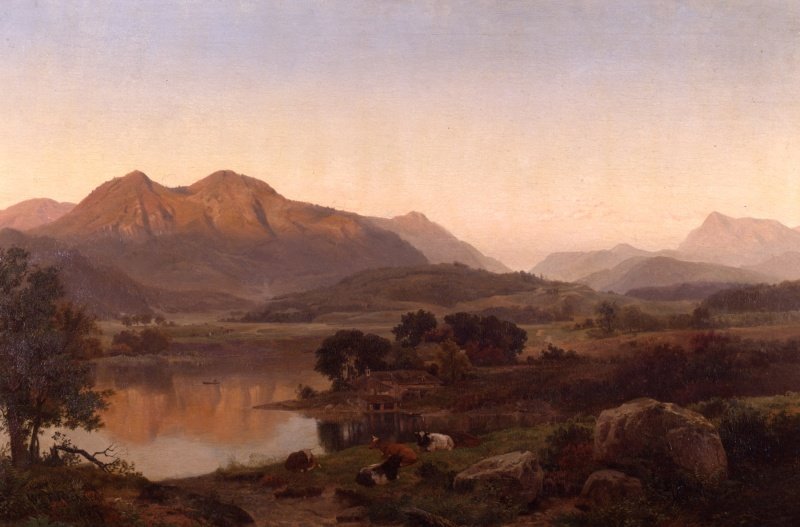
In the Adirondacks, 1857, William Trost Richards
Lessons from the Adirondacks
My senior year in high school my Human Geography class went on a field trip to our own town, Brookfield, CT--a trip that seems superfluous seeing as Brookfield is a teeny tiny town that everyone in my class had lived in for 10+ years. At the outset, it seemed like there wasn't much to learn, but after visiting our Historical Society, several cemeteries, community garden, arts center, and meager business district, I found that there was so much more to my lifelong hometown than I ever could have thought. And although the scale was considerably different, I felt that same sense of awe after coming back from this Adirondack field trip. Seeing all of the diverse aspects of Adirondack life, like the quaint towns followed up stretches of undeveloped wilderness, the vast array of beautiful plants and wildlife, the working farmstead, the museum's account of human life in the Adirondacks, and the people that flock to these places still, helped to solidify what we've been learning in class since August.
We've studied the park from a historical, scientific, and literary lens, and soon enough we'll cover the cultural angle as well. Each of these distinct vantage points offers insight into what is so unique about the region, what made it into what it is today, and where the park falls in all sorts of broader conversations about property rights, wilderness conservation, and the human-landscape relationship. The more that we learn about the park from each of these viewpoints, the closer we get to honing in on what the Adirondacks represent on both a local and global scale and what our successes and failures in those 6 million acres can teach us about where humans fit in to these natural systems.
After seeing the Adirondack artwork, sustainable goat farm, wildlife refuge, and even the more hoity-toity castle-living side of things, I think it would be fair to add a fourth item to the trichotomy of the park: wilderness, playground, home, but also educational experience. There is so much to learn from the Adirondacks, not just in the quiet self-reflection the stonily silent presence of the mountains moves me to make, but in the sense that the Adirondacks themselves represent a blending of wilderness and human activity that is hard to come by these days. As The Atlas refers to it, the park is a sort of "Adirondack experiment" (Jenkins, x) wherein studying the interactions between culture and geology, history and science, economy and regulating bodies, and, perhaps most importantly, the wilderness itself and the now inextricable human presence, can teach us about the natural landscape that we so often take for granted and how we, as humans, can sustainably and justly fit into that vision.
We've studied the park from a historical, scientific, and literary lens, and soon enough we'll cover the cultural angle as well. Each of these distinct vantage points offers insight into what is so unique about the region, what made it into what it is today, and where the park falls in all sorts of broader conversations about property rights, wilderness conservation, and the human-landscape relationship. The more that we learn about the park from each of these viewpoints, the closer we get to honing in on what the Adirondacks represent on both a local and global scale and what our successes and failures in those 6 million acres can teach us about where humans fit in to these natural systems.
After seeing the Adirondack artwork, sustainable goat farm, wildlife refuge, and even the more hoity-toity castle-living side of things, I think it would be fair to add a fourth item to the trichotomy of the park: wilderness, playground, home, but also educational experience. There is so much to learn from the Adirondacks, not just in the quiet self-reflection the stonily silent presence of the mountains moves me to make, but in the sense that the Adirondacks themselves represent a blending of wilderness and human activity that is hard to come by these days. As The Atlas refers to it, the park is a sort of "Adirondack experiment" (Jenkins, x) wherein studying the interactions between culture and geology, history and science, economy and regulating bodies, and, perhaps most importantly, the wilderness itself and the now inextricable human presence, can teach us about the natural landscape that we so often take for granted and how we, as humans, can sustainably and justly fit into that vision.
Domestic Wolves
I was struck by the fact that the couple at the wild life preserve said they had bought wolves from breeders for educational purposes. We've always discussed the wolf as a signature species of true wilderness. I hadn't ever really thought it was legal or intelligent to breed such seemingly wild animals. However, I scrolled through website after website of people claiming to sell wolves, each plastered with photos of wolves (or some mix of wolves and dogs) acting much like domesticated dogs. I struggle with knowing that it doesn't take much to own a wolf. Its hard to imagine, especially after seeing how nervous the wolves were made by us on Sunday, that being bred and shipped across the country to live in cages or act in movies isn't harmful to the species. Its almost as if humans have taken over the species to a point where these wolves aren't fully wolves at all, even the pure blooded ones seem to be missing something essential to their nature when they can only be seen through a fence.


Subscribe to:
Posts (Atom)