Pages

Thursday, October 1, 2015

The ADK Museum

The Adirondack Museum: A Look Back
            While on my class field trip this past weekend, we made our last stop at the Adirondack Museum in Blue Mountain Lake. Most people view National and State Parks as a variation of a museum in itself, as it allows for visitors to view sites that they aren’t able to see in everyday life. Despite the natural beauty of the park, a museum still exists to inform the public about the history of the region and park’s interactions with humans. The museum maintains ten permanent exhibits that are interactive and sometimes even have outdoor components. Some of the permanent exhibits include a history of boats and boating, a history of roads and railroads, and my personal favorite, the history and traditions of logging in the Adirondacks. The logging exhibit featured hands on features, such as feeling specific woods what their use would be. It featured models of the living conditions the loggers lived in and excerpts detailing some of their lives, which can be best described as short and dangerous. It also detailed some transport methods of the logs, which included floating logs down a river and a form of corralling to keep them moving. The term ‘log jam’ was formed when multiple logs would catch onto an area inland and catch more logs until a massive jam was created. Disbanding these logs was quite the chore, often requiring the use of dynamite. In addition to the logging exhibit, the story of Theodore Roosevelt’s journey from the top of Mt. Marcy once he learned the of the impending death of incumbent president William McKinley, including one of wagon’s Roosevelt used to travel from Tahawus to the nearest train station.
            This special museum offers ample opportunity to learn about history of the Adirondacks in a setting that provides a general history of the region, details about certain industries, and even personal anecdotes illustrating the beauty and hardships that encompass the land. The museum’s goal of providing life to the history of the park is wonderfully executed, making it a must see for any visitor to the park.

"The Real Story of the Adirondacks: Yesterday and Today." Adirondack Museum. N.p.,

            n.d. Web. 01 Oct. 2015.

I Get It, Now

Call me a City Girl or a Beach Bum, but I've never considered the mountains to be my favorite place to spend free time. This might be because I grew up close to Boston as well as Revere Beach, the oldest public beach in the country. Growing up, my parents would regularly take my brothers and I into the city to gain an appreciation of what was around us. As we grew, this practice extended into the Massachusetts and New Hampshire coastlines. Naturally, I began to develop an environmental consciousness focused on these landscapes because it was what I knew and loved. I simply never understood the appeal of a sweaty hike up a too-tall hill when an afternoon of swimming or a visit to a museum was so accessible. Of course, I would make these claims without ever having really experienced the other; the mountains.

That is, until I actually got far out of my comfort zone and onto the top of a mountain. On our class field trip into the Adirondack Park, our walk to the summit of Whiteface from the Memorial Highway gave me plenty of food for thought. Although I still haven't spent much time in higher altitudes, I can understand why people fall in love with regions like the White Mountains in New Hampshire or the Adirondacks. Simply, being able to stand and see hundreds of yards in any direction is breathtaking. It is such a unique perspective to be able to see 60 miles, as was the case this past weekend atop Whiteface, that accurate description almost escapes me. Words like "beautiful" or "organic" do not accurately convey the scope of the view or personal emotions felt at the top of a mountain.

Beyond the view, I also noticed how many people were willing to wait in line and pay up to $11 a head just to have the opportunity to walk up a steep path and stare into nature. While this type of tourism is nothing new for me, it seemed somehow out of place. Aren't the tops of mountains, by nature, small? How could this many people feasibly interact with this tiny area without toppling the thing? Why was there such an emphasis on the top and not the entire formation? I don't have the answers to these questions, regardless I can still understand the inexplicable need to participate in the tourist phenomenon.

Similar to my feelings toward the mighty Atlantic on a summer day, these "Mountain People" needed to commune with nature by any means necessary. Is is this deeply personal need to connect with a massive landscape that drive beach goers to fight for towel space and mountain appreciators to wait patiently for their time at the top. For me, there is something comforting in the fact that in this age of increasing alienation from one's environment, there are still huge populations of people that cannot help but share an experience for the sake of nature.


Works Cited

http://reverebeach.com/

http://www.whiteface.com/activities/whiteface-veterans-memorial-highway


Free Range Bacon

           The invasion by non-native species in to an ecosystem threatens the biodiversity, human and animal health, and can even have economic impacts in a region.  The development of transportation has created a global world in which organisms are offered an opportunity to reach parts they would never exist in naturally.  We are beginning to understand how fragile the balance of native species in an eco system is after witnessing havoc created by non-native species.
            One of the only invasive mammals found in the Adirondack Park is hard to define as non-native because it essentially escaped from our own backyards.  Popular TV shows such as American Hoggers and Hogs Gone Wild focus on the wild hog issue in the south but many New Yorkers and New Englanders aren’t aware of their presence in the North East.  The hogs terrorizing farmland in the Champlain Valley are escaped livestock, domestic pet pigs, or Eurasian boars, which escaped from hunting reserves (adkinvasives.com).  Populations have increased due to the pigs ability to begin reproducing at 6 months and bearing litters of up to 10 offspring (Foderaro).  As shown in the TV shows on A&E and Discovery the pigs can often be aggressive towards humans, and develop sharp tusks.  The pigs have become pests to local farmers because of their large appetites which they are known for.  Feral pigs will eat almost anything including native vegetation and crops, fawns and domestic livestock, as well as low nesting birds and reptiles (Foderaro).
            Farmers and state officials are eager to eradicate the feral pig population that threatens the already fragile agriculture of the Adirondacks.  The state originally permitted open season for any hunter with a small game license in the state of New York (Foderaro).  The open season policy actually elevated the issue of feral pigs as the pigs were learning from failed trappings of herds and never returning to trap sights again.  The act of hunting the pigs actually further dispersed the population as one or two pigs were being taken down and others were escaping (Foderaro).  The pigs intelligence has forced the DEC and New York State to prohibit feral pig hunting so that they can “ensure maximum effectiveness of DEC’s statewide eradication efforts” (Adirondack Almanac).  While it is a very serious threat to viability of agriculture in New York State, it is hard not to chuckle at the thought of pink pigs running around wreaking havoc and outsmarting hunters and farmers alike in the Adirondack region.
           
Cited


"Meat" These Cool Plants!

While at the Wild Center this weekend, one exhibit in particular caught my eye: carnivorous plants (if you can’t tell from my previous post, I really like plants…).  The exhibit featured a massive sculpture of a pitcher plant with a to-scale version displayed next to it.  Aside from the classic Venus Fly Trap, I didn’t know of any other carnivorous plants that existed.  I especially didn’t know I could find one right in the Adirondacks.  The pitcher plant uses its red “lips” in order to attract insects.  The insects then follow a trail of nectar that leads down the tube of the plant, not knowing that they will be unable to escape due to downward pointing hairs lining the tube.  Eventually, the insect falls into the plant's pool of digestive enzymes that sit at the very bottom of the tube.  Pitcher plants don’t exclusively eat insects - they occasionally eat frogs! Creepy, right!?

Pitcher Plant Sculpture at the Wild Center (Photo Credit: Jared)

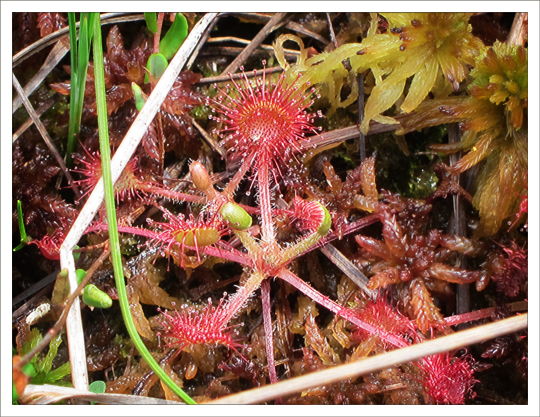
As I continued to look at the exhibit,  I was shocked to find that there was more than just one carnivorous plant in the Adirondacks.  The Roundleaf Sundew gets its name from the dew-like droplets on its leaf hairs.  When insects come to investigate the sweet smelling leaves, the mucus traps them, and the leaf curls around the prey releasing a digestive enzyme that allows them to absorb the nutrients of the insect. This video demonstrates the process.

Roundleaf Sundew  (Paul Smiths VIC)
http://adirondackvic.org/Adirondack-Wildflowers-Roundleaf-Sundew-Drosera-rotundifolia.html

But that’s not all!  There is third carnivorous plant present in the Adirondacks- the Bladderwort.  These plants either float on the surface of the water or sit on waterlogged banks. The “bladder” of the plant has a lid on it, which closes to create a vacuum.  Sensitive hairs line the outside of the plant, so when prey (which can include water fleas or even small tadpoles) passes by, the plant opens its lid.  The vacuum pulls in water and any unlucky creature nearby.  Once inside the bladder, digestive enzymes and bacteria begin to digest the prey.  This video shows the process (skip to 45 seconds to see the action).
So why do these scary, sci-fi plants even exist?  These types of plants mainly live in bogs.  As we talked about in class, bogs are acidic and lack nutrients (and the few nutrients that are present are taken up by the sphagnum).  In order to survive in such nutrient poor conditions, the plants supplement the nutrients available in the soil with the nutrients from insects and other prey.  Another way in which plants are totally awesome!


Works Cited
"Adirondack Wildflowers: Pitcher Plant (Sarracenia Purpurea)." Adirondack Wildflowers. Paul Smith's College, n.d. Web. 30 Sept. 2015. <http://adirondackvic.org/Pitcher%20Plant%20--%20Sarracenia%20purpurea.htm>.


"Adirondack Wildflowers: Roundleaf Sundew (Drosera rotundifolia L.). " Adirondack Wildflowers. Paul Smith's College, n.d. Web. 30 Sept. 2015.


Rathbone, Ellen. "Bladderworts: Pretty, But Deadly Adirondack Natives"  Adirondack Almanack. Accessed: 30 Sept 2015.
<http://www.adirondackalmanack.com/2010/08/bladderworts-pretty-but-deadly-adirondack-natives.html>.

Wednesday, September 30, 2015

The History of the Adirondack Chair

While I’ve been sitting in adirondack chairs for as long as I can remember, this weekend was my first time sitting in an adirondack chair while I was actually in the Adirondacks. This chair is found on everything from souvenirs like mugs and keychains to welcome signs, to the front porch of the great camps, so is clearly an integral part of Adirondack history and culture. This prompted me to wonder how adirondack chairs have become so widespread outside of the Adirondacks and what their origins were.

The adirondack chair was invented in 1903 by a man named Thomas Lee, while he was vacationing in the Adirondacks. He came up with the design after becoming dissatisfied with the poor quality of his lawn furniture. He tested over twenty different designs amongst his family members before deciding on the one we know as the modern adirondack chair – wide arms, a sloping back, and deep seat. After the chair was patented by a carpenter not long after, it began to gain more local attention. However, it wasn’t until the 1920s that the chair began to gain more popularity and began appearing in photos and paintings of the Adirondacks.
Adirondack chairs on the dock at Camp Wenonah

Today, many large companies continue to manufacture the adirondack chair, keeping up with its continuing popularity. However, while some are satisfied with a cookie-cutter chair from llbean or smith and hawken, others prefer to search for the antiques. While old adirondack chairs do exist, they are considerably harder to find. One would have to seek out a multitude of summer flea markets or antique sales before finding an original – especially if they are looking for pristine condition.

These chairs have spread far beyond the Adirondacks, and are now just as likely to be found in a California garden or at a Nantucket beach house. While the Adirondacks definitely had a slow start and have struggled to maintain vitality over some years, the adirondack chair has persisted as a symbol of summer across the nation.

Works Cited:

Price, Debra Muller. "Adirondack Chairs." Country Living 25.7 (2002): 69. MAS Ultra - School Edition. Web. 30 Sept. 2015.

The Bees and the Trees

The honeybee is an unsung hero in many of the world’s ecosystems. Yet, these bees are starting to receive some appreciation and attention due to the unfortunate circumstances of Colony Collapse Disorder (CCD), a condition in which honeybee colonies experience inexplicable population drops when bees leave the hive and never return. There is still no definitive explanation for the cause of CCD, but scientists have begun extensive studies to get to the root of the problem, fearing that human activity may be a major contributing factor. Thus far, studies have identified a number of potential culprits, including common honeybee parasites and pathogens, chemical toxins and insecticides, and destruction of natural habitats.
Habitat destruction is especially concerning, as it is most directly linked to human activity. Studies suggest that honeybee habitat loss resultant of human activity can correlated with CCD incidence. The number of honeybee colonies in the United States has steadily declined for the last 30 years, and coincides with substantial decrease in total cropland, pastureland and rangeland area in the United States as land becomes developed. Following this trend, fewer types of pollen and fewer potential hive sites are available to the honeybees in developed areas, which may contribute to malnutrition and colony instability.[1]
In this race against time to identify the causes of CCD and develop remedial programs, one study had emerged from the Adirondacks, and the results may be surprising. One team of scientists studied the northern hardwood forests, and in true Adirondack fashion, to identify the effects of logging on midsummer diversity in native bee populations. They measured bee abundance and diversity on a series of 5-acre plots two and three years after experimental logging removed 30, 60, or 100% of the trees. They found that logging actually led to a significant increase in native bee diversity and abundance. Data show the most bee abundance on plots where 60% of the trees were logged, leaving a thin canopy and mostly open, sunny ground. Bee abundance was ten times higher in 60% logged plots than in 30% logged or clear-cut plots, although bee diversity was highest in clear-cut plots.[2]
The scientists reasoned that logging treatment influences the floral resources available to bees. Tree removal allowed more sun to reach the forest floor, encouraging growth of flowering herbaceous and weedy plants that bees need for nutrition. And since most critters will follow the food, bee populations are often directly correlated with flower abundance. Logged areas might also increase types of hive sites for bees, such as dead wood (slash) and weeds, which may help colony stability. [2]
This study suggests that some things are good in moderation. Humans may not be as destructive as is assumed, although we have a long way to go until we can live in complete harmony with nature. Still, Dean Thompson, a beekeeping hobbyist in the Hamilton College community estimates that beekeeping is becoming more popular a result of the spreading news about Colony Collapse Disorder. We need more research and awareness of honeybee welfare before CCD can be tackled in any definitive way, but for now, the bees keep buzzing and the rest of us have reason to hope. 


[1] Naug, Dhruba. "Nutritional Stress Due to Habitat Loss May Explain Recent Honeybee Colony Collapses." Biological Conservation 142.10 (2009): 2369-372. Print.

[2] Romey, W. L., J. S. Ascher, D. A. Powell, and M. Yanek. "Impacts of Logging on
Midsummer Diversity of Native Bees (Apoidea) in a Northern Hardwood Forest." Journal of the Kansas Entomological Society 80.4 (2007): 327-38. Web.

Blurred Lines


After learning of the lawsuit filed against writer and editor Phil Brown for trespassing and canoeing through private property I became curious about legal battles with the law concerning this land. It seemed curious to me, that an area that so greatly emanated the value of freedom, could have so many lawsuits and restrictions.
In 2013 a case was filed against the New York State Department of Environmental Conservation and the Adirondack Park Agency for preventing the maintenance and construction of new trails within the forest preserve. Protect the Adirondacks argues that the expansion of snowmobile paths disturbs the park, imposing negative ecological impacts on the environment. This claim holds some validity for those fighting the case. The paths needed for snowmobiles to run through the park aren’t really “trails”, but more like roads, expanding to widths of 12 feet or wider. Description: Macintosh HD:Users:charlottewyman:Desktop:MRP-Snowmobile-Trail-7.jpg
More importantly, however, they believe that through the construction of these large paths, the park is also permitting the use of large mechanical snow grooming machines on certain snowmobile trails. This is a key component of this case; PROTECT emphasizes that the lawsuit is not about eliminating the use of snowmobiles on the the Forest Preserve, but that it is about eliminating motor vehicle use that might further harm the trails and create noise disturbances for those living in the area.

Overall, this is a hard case. The line between environmental preservation and allowing what is beneficial to the development of the Adirondacks is often blurred in this area. By creating new paths for other types of motor vehicles, the park is working to attract other types of tourism and business that could bring more people to the area. This would bring the beauty of the Adirondacks further into the eye of the public, and perhaps the mindset of natural preservation could be spread outside the park and into the rest of our country Yet, this potential economic and social progress comes at a price. Mckibben would claim that this invasion of the land reflects our hyper individualism. Is the use of motor vehicles really worth the sacrifice of what we consider the last remnants of undisturbed wild? Can’t we learn to appreciate the land for what it has to offer, without imposing on it with our own establishments? We must learn to decide what is more beneficial to us, the economic expansion of this land, or maintaining it’s preservation and purity as the last remaining forms of wilderness.