Pages

Monday, October 6, 2014

The Old Adirondack Days

This weekend I stepped back in time and saw the Adirondacks as the wilderness it once was. First, we travelled back to the 1900’s in Litchfield Castle, where Pieter Litchfield was kind enough to open up his home to Hamilton. This amazing and unparalleled experience of staying over at such a great historic site was unforgettable. Every piece in the home transported us back to a time when the Adirondacks was seen as a truly wild land. Mr. Litchfield told us a story of how the first Mr. Litchfield who bought the property and built the castle introduced exotic animals onto the estate to create his own wildlife preserve and personal hunting grounds. Although the animals were not in their native habitats and eventually died off, it reveals how the Adirondacks was seen as one of America’s last chance to remain wild.
            Asgaard Farm also reflected a time when self-sufficient farming was the norm. Although Asgaard Farm is not there yet, they are on their way to being entirely self-sustaining. They reminded me of an era where small, family run businesses supplied locals, much as Asgaard Farm is trying to accomplish today. The couple, David and Rhonda, was kind enough to give us a tour and history of their land. Their property was home to Rockwell Kent, an American wilderness painter from the 20th century. They bought the property in 1988 and decided to restore the old farmstead back to its glory. All of the buildings are original and it looks much like Rockwell Kent’s painting of it when it was his home.
            Although one can argue that Asgaard Farm is going back to the basics when it comes to farming, sustainability is also a relatively new trend. This juxtaposition of new methods and old concepts makes Asgaard and other sustainable farms so intriguing. Many times these farms adopt older practices that avoid using chemicals or inhumane slaughtering of animals like commercial farms employ. Also, many industrial farms mass-produce a select product, known as a monoculture, without a variety of crops or livestock to help maintain soil quality and the health of the land. This diversification of sustainable farms is the key to making the land profitable. David and Rhonda joined this movement and added cows, chickens, and a small vegetable field to Asgaard. While the Adirondacks moves into the twenty-first century, it is nice to see how old-time traditions still prevail and preserve the history of the park.

Asgaard Farm

Chaga Chaga Choo Choo

One of my favorite parts of the field trip was getting to see and talk with people who lived in the Adirondacks and made a living doing various things, wether it be knitting, spinning, dairy farming or fur trapping. The 16 year old trapper from the Adirondack Museum was an especially memorable person. Besides doing fur trapping, he also collects and sells Chaga fungi. I had heard of Chaga before because of its remarkable health benefits but I had no idea that it grew in the Adirondacks. After doing more research I've learned that Chaga grows on living birch tress throughout the northern temperate and subarctic forests in the Americas, Asia, as well as Europe.


Another cultivater that I found online describes Chaga as being a polypore fungus that only grows on a living tree. Most commonly, the fungus grows from a bruised part of a tree, that suffered damage and lost a branch. By growing on the bruised part of a tree, Chaga prevents rotting and infection on the tree. Chaga has the ability to prolong the life of a birch tree, but eventually when the birch tree dies, the Chaga does as well, but not before releasing spores in the wind.

Chaga traditionally is credited with treating cancer, leukemia, acne, blood disorders, and psoriasis among other things. Some people claim that it can help in the treatment of HIV. Some of the beneficial components of Chaga are apoptosis-inducing like Betulinic acid which has an effect on the mitochondria of cancer cells.

In many cases, and the case of the boy from the museum, Chaga is brewed into a tea and consumed. When I drank it, it had a very distinct fungal taste as to be expected. It wasn't bad though, and considering all of the health benefits, it's worth it. This was a very informative and unexpected activity  that contributes to the economy of the Adirondacks that I'm glad to have learned about.


First time in the ADKs

Unlike many hoc members and AA leaders in this class, this weekend was my first real experience in the Adirondacks.  I really enjoyed the trip and I felt that I had a good background knowledge about the history of the park and people who have lived there. I also really liked seeing, in real life, the diverse Adirondack trees, mountains and landscapes that we have been learning about for a while now.  I’m glad that we went during this time of year, because it was really cool to see all of the beautiful different colors of the changing trees.  The good thing about the long time spent in the jitney, travelling to and from places was that I had lots of time to stare out of the windows and see many different colored trees fly by.

One lasting impression that will stay with me from this trip was when we were standing on Asgaard farm looking at the landscape. We were looking at the surrounding mountains replete with trees, and we were told to imagine standing in the same exact spot 100 years ago because we would be looking at bare mountains due to the effect of harsh logging.  While standing on that farm and seeing thousands of trees it was very hard to imagine a bare landscape; the trees were so abundant.  I could kind of see how some old settlers and loggers thought that the trees in the Adirondacks were infinite and therefore a great resource.  But research and history tells us that even though the trees may look infinite they are very vulnerable to human activity and we should not take them for granted.


Here is a photo I took of the tree filled mountains from the farm.


What Really is a Local Farm?

Perhaps my most favorite part of our trip to the Adirondacks this weekend was our trip to Asgard Farm. Before our visit, the term “local foods movement” had just been a phrase I had accepted to mean “organic small farms.” Visiting Asgard enabled me to grasp a real example of what the phrase “local foods” exactly entailed.

The couple who owned the farm mentioned that they have approximately 45 milking goats, and were currently contemplating whether or not raising their heard to 60 would be too much given the size of their 1,500 acres. In the fall, the does are mated and by springtime, they give birth to “kid” goats that will either replace members of the milking herd or be raised for meat. The milking goats spend much of the year (including the winter) outside, as the owners indicated that they are often reluctant to move the heard inside. Moreover, the owners take pride in the fact that they sell a great portion of their kid goats to Heritage Foods in New York City as part of their innovative program their “no goats let behind” policy.

Apart from their goats, Asgard farm also raises cattle, mainly Devons. They also cross Devons to Red Angus and Herefords, which result in offspring that will possess the best qualities of both breeds. Their cattle are 100% grass fed, and in the winter they shift to a hay diet. The owners emphasized that the cows are never fed the special “feed” that cows are subjected to at large corporate farms. In supermarkets, I will often see a label reading “grass fed beef,” but it was not until visiting Asgard that I was able to make the connection between where the cows are raised to where the meat ends up.


One of the aspects that make Asgard Farm a true “local farm” is the fact that they attend local farmers markets and do not ship any of their cheeses or other products south past Albany. As Albany is approximately 150 miles south, even that stretches the definition of a local farm. Nonetheless, as I was traveled through the farm, walking from the goats to the cows to the chickens, I took a moment to take in the view of Whiteface Mountain, and realized that this couple wakes up to this view all year round. The foliage and temperatures change, but if it were me, the view of whiteface alone would be enough motivation to get me out of bed in the morning.


Pressing Reset

For me, going to the Adirondacks, is like pressing the reset button. I have always thought this, but after this weekend (which was a different Adirondack experience containing countless hours in a car, numerous museums, and two great camps) Im convinced it's true. Weather it's a solo hike that leave me sore, leading an easy canoe trip with incoming freshman, or a tour of the Adirondack Park through history and place, I always leave feeling new. When we went to the museums and refuges I found myself thinking that I would never have gone to these places outside of the class, but Im so happy I got the chance. I felt small so many times. Besides the daunting castle, with its extinct animals hanging on the walls, I felt insignificant at the refuge center, as I stood in awe of the wolves and bald eagles (things often reserved for post cards), tiny knowing that it only takes a half mile hike to get to views that go for miles, and even smaller knowing that at the end of our trip we had only seen a fraction of the park. Im not sure if it was the laughter I shared with my classmates (who I probably wouldnt have spoken to for the entire semester if it hadnt been for the closeness the vans forced us in to), the unbelievable colors leaves turn in the fall, the seclusion I felt at times, the things I learned about a place I love, or just the trip as a whole, but today I feel new(ish). Maybe this is why Litchfield Castle has a driveway that takes 30 minutes to get down. Perhaps this is the reason that every year the people at Winona Camp open their houses to us. These people understand the power of watching the seasons change away from pavement and cities, the value of seclusion, and the many benefits a place like the Adirondacks have.

Today, we even use science to show the value of Nature:

http://www.outsideonline.com/news-from-the-field/Study-Hiking-Makes-You-Happier.html?utm_reader=feedly&utm_content=bufferedf66&utm_medium=social&utm_source=facebook.com&utm_campaign=buffer

The Castle

I just wanted to take this blog space to talk a little bit about how remarkable the experience at Litchfield Castle was. It was an absolute treat just wandering around the place. From paintings of Henry IV of France to alter pieces "acquired" from European churches and to the unavoidable trophies of the hunt from an European-dominated Africa, the castle oozed with an unbridled aura of European nobility. The castle simply had a transportive power to it that made you feel important for just stepping foot in it. The highlight of the trip for me at least was listening to and engaging with Bob Hamill and Peter Litchfield well past midnight with the students that stayed at the castle for the night. It was during these couple of hours that I found out that there was another person named Bayard that once
lived on this earth, besides myself and the civil rights activist Bayard Rustin. Bayard S. Litchfield was Peter's grandfather and he published a book with all the purchases, i.e. paintings, suits of armor, guns etc., the family had made to date two generations ago. The trip as a whole blew away my expectations and staying at that castle for a night simply made me feel regal. Thanks to everyone who made this trip possible.

"I don't want petty self-expression. I want the elemental, infinite thing; I want to paint the rhythm of eternity."


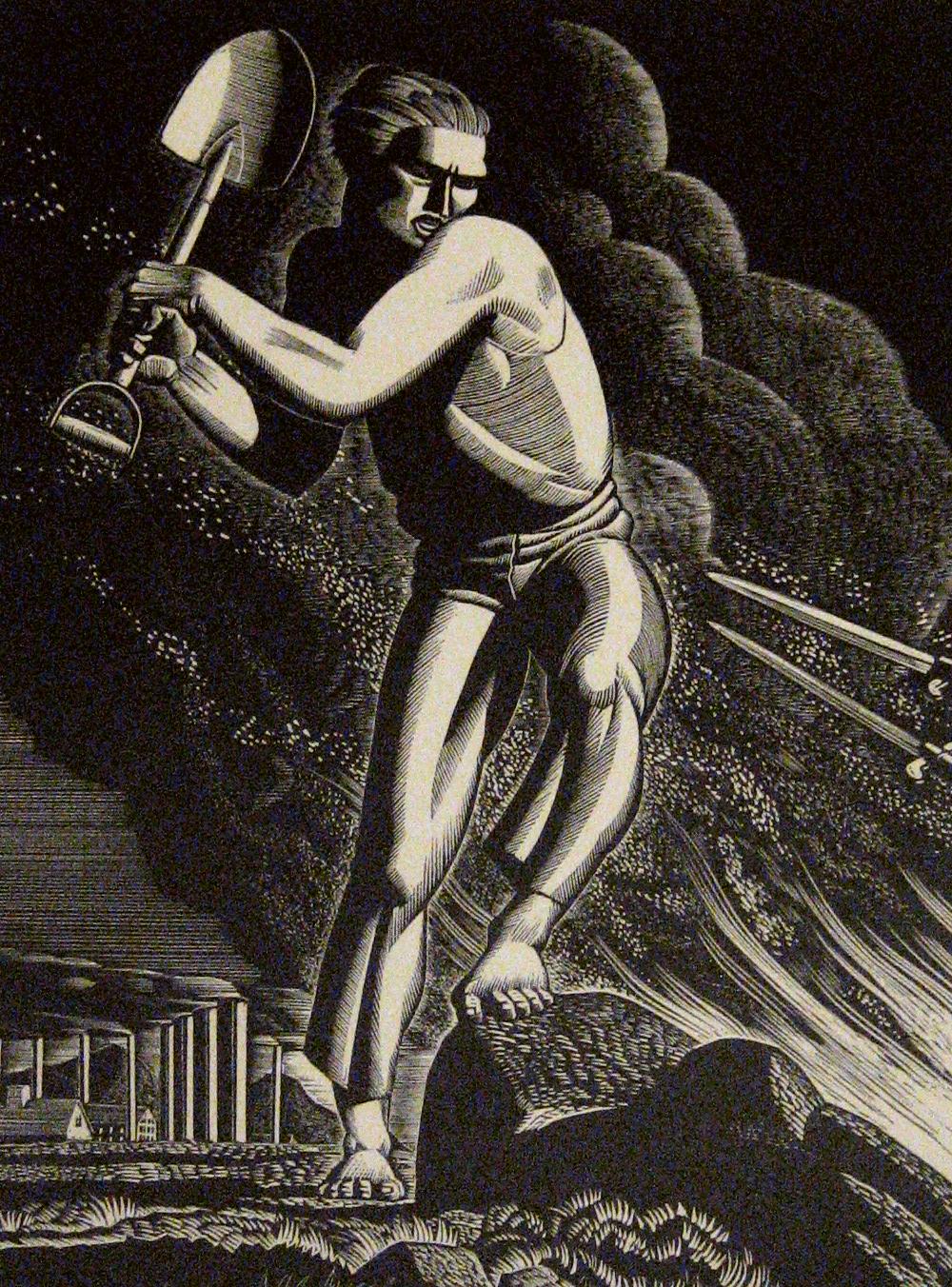
I had never heard of Rockwell Kent before our trip to Asgaard so I decided to look a little deeper into his story and artwork. He was known for being a talented painter, printer maker and illustrator. He was heavily influenced by the works of Thoreau and Emerson and found inspiration in the stark beauty of the wilderness. Over the course of his life he traveled extensively and called Minnesota, Newfoundland, Alaska, Vermont, Tierra del Fuego and Greenland home for extended periods of time.  While in Alaska he published Wilderness (1920), a travel memoir comprised of his letters home as well as illustrations. Kent was also approached by a publisher in 1926 and ended up illustrating a limited edition of Moby Dick (1930). The edition sold out almost immediately and many cite the success of this specific illustrated edition as a huge factor in the recognition of this work as a classic today. He also illustrated editions of Leaves of Grass, Candide, Faust, Canterbury Tales and Beowulf. His black and white prints and illustrations were popular and powerful and matched the tone he austere tone he often hoped to capture. A contrast between nature and civilization was often central to his work.

 "...in the 1930s, he reached his greatest popularity. In 1936, the magazine Prints conducted an extensive and elaborate survey on the practitioners of graphic art in the United States. Kent came out far ahead of all others as the most widely known and successful printmaker in the country." 

But his consistent support of radical causes lead to a decline in his popularity during the 40s and 50s. Kent became very popular in Soviet Russia and almost half of a million Russian attended an exhibit of his work. In 1967 he was awarded the Lenin peace prize, which was mainly awarded to prominent Communists and supporters of the Soviet Union who were not Soviet citizens. Unfortunately at this point much of his work was denounced due to political reasons despite its quality. It is crazy to think that just this afternoon I was standing in his studio in the Adirondacks and that I could hold the same tools he used to craft his work. After witnessing the stunning views from the property it is no surprise he drew upon it so heavily. I am very curious to explore how other artists and intellectuals were inspired by the park and thankfully will have a formal opportunity to do so with my presentation on the Philosophers' Camp. 

Here is a relatively thorough Bio of Kent from SUNY Plattsburgh: http://clubs.plattsburgh.edu/museum/rk_bio.htm

One of Kent's Illustrations from Moby Dick (1930)