Pages

Showing posts with label Posts. Show all posts

Monday, April 25, 2016

Old Plane Crash Sites


Hidden among the 6-million-acre Adirondack Park lie the remnants of dozens of wrecked planes. They include single-engine private planes, military jets, and even commerical planes. While some wreckage has been recovered, other planes are either left behind and visited by hikers or have completely vanished without a trace. As dozens of wrecks remain undiscovered, one forest ranger has spent hundreds of hours going through records, interviews, and the Adirondacks looking for these crash sites hoping to bring closure for families.


Aviation Archaeologist
Scott Van Laer (Associated Press)
Forest Ranger Scott Van Laer has documented over 200 crashes and has visited over two dozen sites (Associated Press). Some of these sites hold military history such as the crash on Blue Ridge where a U.S Army C-46 transport plane crashed in 1944 during a night training mission (Associated Press). The crash killed all three men on board and was not found until a year later. Furthermore, as Van Laer searches for these sites, he also seeks out surviving relatives to see if they want to visit the wrecks. Two years ago, Van Laer’s offer was accepted by a man who wanted to see his father’s plane wreckage for the 45th anniversary of the crash. The forest ranger led the son to the wreckage of a Cherokee 140 on Iroquois mountain which his father actually survived through (Associated Press). While some of these crashes have an happy ending, others are not as lucky. For example, in January 1971, a twin-engine jet containing five men on board crashed shortly after takeoff from Burlington, Vermont and has still not been found (Associated Press). The family of the five men continues to wait for answers while Van Laer hopes to bring them closure as soon as possible. Containing dozens of undiscovered crash sites, this 6-million-acre park holds the same answers for the family of five as for many other families. As these searches continue, you have to wonder how long these families have waited and how much longer they must wait until they find their answers.


Works Cited:

Press, Associated. "Adirondacks Ranger on Mission to Find Old Plane Crash Sites, but Mysteries Remain." Syracuse.com. Associated Press, 24 Apr. 2016.

Tuesday, April 19, 2016

New York Pays $14.5 Million for the Boreas Pond Tract


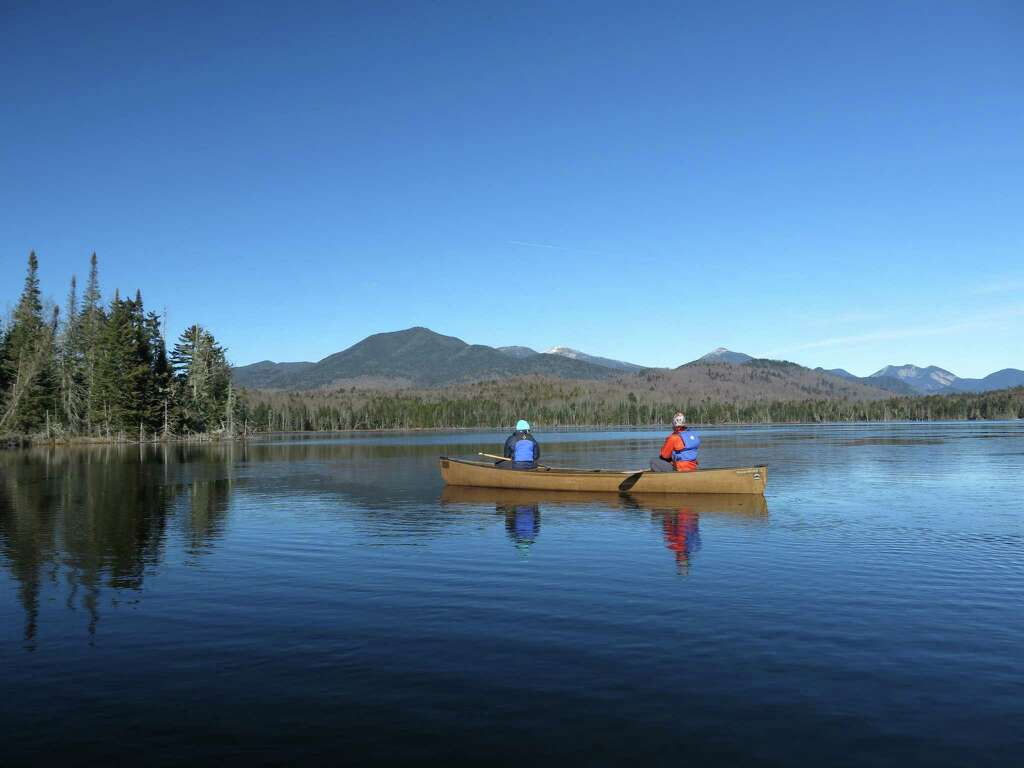
In a park plagued with various land issues over motorized versus “hike-and-paddle” access, the Boreas Pond Tract is currently in the middle of a tug of war. After the governor announced plans to purchase the private and unclassified tract from the Nature Conservancy, debates flared up between local businesses and conservationists. The debate has been elevated to the next stage as the New York State has recently finalized the purchase of the tract.

Photo from TimesUnion


For $14.5 Million, the New York State purchased over 20,000 acres earlier this month, completing Governor Cuomo’s 2012 planned acquisition of 69,000 acres from the Nature Conservancy (Bradley). The next step in the process for the state is to develop a management plan for the area to determine how the Boreas Ponds will be used. Environmental groups are pushing for the tract to be added to the adjacent High Peaks Wilderness to create a preserve larger than Rocky Mountain National Park (Esch). Opposition groups are pushing for the tract to be classified as “wild forest” which will result in less restrictions for snowmobiles and other mechanized access, bringing in more tourism dollars (Esch). The issue at hand is part of a much bigger and complex problem. While some believe the Adirondacks should be left alone as much as possible and only used for wilderness recreation, others are prioritizing the economy and encourage development even at the expense of the natural lands. As the tug of war comes to an end, both the agenda of the New York State and the future of the Adirondacks will soon be unveiled.


Sources:
Bradley, Pat. "New York Buys Boreas Pond Adirondack Tract For $14.5 Million." WAMC. WAMC, 14 Apr. 2016.

Esch, Mary. "Hike vs Ride: Debate Heats up over next Adirondack Land Buy." The Big Story. AP, 29 Nov. 2015.

Tuesday, April 12, 2016

World's Largest Garage Sale


One man's trash is another man's treasure. This is the perfect quote to use if you were describing a garage sale to someone who has never heard of one. These events are the time of year where you look through your neighbor's junk hoping to find a priceless family heirloom or simply just an interesting book. Regardless of your purpose, the scene is almost always the same. One house, a few neighbors, and a whole lot of items with various price tags. Now take this scene, and multiply it by 100,000 people. 

garage_overhead
Image from Warrensburg Chamber


In October, more than 100,000 people travel to Warrensburg, NY, for the World's Largest Garage Sale (Healy). From all over the country, countless vendors go to Warrensburg to sell antiques, memorabilia, books, furniture, clothing, family heirlooms, children's items and whatever junk they want to get off their hands. This event is held annually on the weekend prior to Columbus Day weekend. 

The town of Warrensburg is clearly profiting from this event and have taken steps to continue attracting visitors and to attract even more the following years. They have partnered up with a nearby railway to offer special "Garage Sale Train Tickets" which allow passengers to "enjoy the beauty of the fall foliage" on their 1.5 hour ride (Warrensburg). On arrival, visitors can start enjoying the sales or take a free shuttle service around Warrensburg. Recently, the town has also created a family fun zone which includes a playground area, music, and other entertainment. The "World's Largest Garage Sale" definitely brings in a lot of money for the town. Not only are they providing cheaper transportation to the event, they are providing free transportation around the town. During this period of tourist boom, I wonder how nearby towns are affected. 


Sources:

Ahealy@syracuse.com, Allie Healy |. "World's Largest Garage Sale in Adirondacks: Guide to Parking, How to Avoid Traffic, More." New York Upstate. New York Upstate, 4 Apr. 2016. 
Warrensburg. "Garage Sale." Warrensburg Chamber or Commerce. Warrensburg, n.d. 


Tuesday, April 5, 2016

Consequences of Animal Traps


Animal trapping in the Adirondacks have always been a highly controversial topic debated between trappers, who are trying to make a living, and opposition, who are looking out for the well-being and ethical treatment of animals. While hunters and trappers bring over $700 million a year to the New York State, the consequences of animal traps appear to outweigh the positives (ADKWLC). Non-targeted animals are commonly caught in the trap, which includes pets, birds, or other wildlife. As these animals are trapped, they suffer greatly and either fall victim to predators or are released back into the wild with injuries that will eventually lead to their deaths. Long periods of struggle is frequent as hunters are not legally required to check the trap more than once over a 24-48 hour period (ADKWLC). Accidental trapping in the Adirondack area may be more common than most people assume as birds, pets, and even bears have fallen victim.

trapped eagle
Photo by DEC

In the village of Chestertown, located in the Adirondacks, a pet dog died after its head was unintentionally caught in a beaver trap (Grondahl). Another incident of an accidental trapping occurred in Brushton, where a large female red-tailed hawk had been caught in a trap and lost one of her legs (ADKWLC). Similarly, a bald eagle got caught in a trap but was able to loosen the trap's chain and flew away with the chain attached before being entangled in the branch and left dangling (ADKWLC). Both birds survived and were rescued but a barred owl was not as lucky as it flew around with a trap on its leg and eventually died (ADKWLC). Lastly, a grizzly bear was caught in a leg-hold trap and was forced to bite off its own paw in order to escape (ADKWLC).

While these accidental trappings were reported to the Department of Environmental Conservation and North Country Wildcare, many of these accidents go unreported. These non-targeted animals are either disposed of by trappers, eaten by predators, or released back into the wild with life-threatening injuries. Even with the economic benefit of trapping, the consequences, which include prolonged suffering and trapping of non-targeted animals, are devastating. With an increase of publicity for similar incidents, the New York State is now under pressure to either ban trapping or find a way to shorten suffering and prevent non-targeted animals from being affected.


Sources:

Grondahl, Paul. "Dog Dies after Caught in Beaver Trap in Adirondacks."Times Union. Times Union, 2 Apr. 2016. 

Adirondack Wildlife. "Leghold Traps." Adirondack Wildlife. Adirondack Wildlife Refuge, n.d. 

Tuesday, March 29, 2016

The Adirondacks: Truly Uninhabitable?


Originally viewed as an uninhabitable area, the Adirondacks today have quite a few people living in it. There are over 100 villages and towns that make up a population of over a 100,000. This isn't too shabby considering the Adirondacks were first seen as desolate and unforgiving. Furthermore, the six million acre land attracts millions of visitors each year and brings in a nice chunk of money for the New York state. However, what is commonly less known is the many disappearances or deaths of experienced hikers and hunters. Are the Adirondacks truly uninhabitable as originally thought or are these accidents not unique to the Adirondacks? Despite the successes the Adirondacks have seen so far, the many fatalities appear to be a product of the unforgiving and desolate nature of the park. 

Adirondackalmanack.com


Some of these fatalities include Thomas Messick, Douglas Legg, Matthew Potel, and Hua Davis. Back in November, Thomas Messick, age 82, suddenly vanished when he was hunting deer in an area of wild forest near the town of Horicon in Warren County. Messick was with a group of hunters who had been hunting together in the Adirondacks for decades. Similarly, Douglas Legg who was described as an avid hiker and mini woodsman, disappeared almost 45 years ago on a short and direct walk back to his camp. Next is Matthew Potel who was an outdoors educator and experienced climber. On his last hike, he slipped and fell head-first to his death when he attempted to climb the Trap Dike with seven other members of his school's outdoors club. Once again, a similar situation occurred involving Hua Davis. Davis was a Saranac Lake Ultra 6er meaning she was able to climb all six Saranac lake peaks in one day. Clearly an experienced and avid hiker, Davis was found dead after setting out on a hike up MacNaughton Mountain. 


Tuesday, March 8, 2016

Another Death in the Adriondacks


Originally viewed as an uninhabitable area to settle, the Adirondacks today have quite a few towns. There are over 100 villages and towns that total up to a population of over a 100,000. This isn't too shabby considering the Adirondacks were first seen as desolate and unforgiving. As a matter a fact, the six million acre land attracts millions of visitors each year and brings in a nice chunk of money for the New York state. What is commonly less known, is the disappearances or deaths of experienced hikers and hunters. 

Hua Davis (Syracuse.com)

Last Saturday, an avid 61-year-old hiker from Wilmington, Delaware passed away on the western slopes of MacNaughton Mountain due to hypothermia. MacNaughton Mountain has a summit of 3,983 feet and the temperatures that night reached below zero. Davis left her party and set out to hike on her own but did not return the next day which prompted a search-and-rescue mission by state rangers and police. After finding her body, a forest ranger fell through the ice of a brook or creek and was submerged chest deep in water. As a result, the rangers who were conducting the rescue mission requested an emergency extraction and had to be rescued themselves.
Hua Davis was a Saranac Lake Ultra 6er which meant she was able to climb all six Saranac Lake peaks in one day. 
How is it that so many hikers and hunters fall victim to the Adirondacks despite being so experienced? Are these accidents common occurrences not unique to the Adirondacks or is the park really as desolate and unforgiving as originally thought? 

Tuesday, March 1, 2016

Mount Colden Trap Dike


The Trap Dike after Tropical Storm Irene. The slide at the top of the dike is new. Photo by Carl Heilmann II.
Trap Dike in Mount Colden (Adirondack Explorer)
Located in the Adirondacks, Mount Colden is well known for its Trap Dike which is a large crevice that runs up the center of the mountain. The dike takes around an hour or two to complete and has an ascent of two thousand feet. It can be seen by many hikers across the water on Avalanche Lake's west shore. However, hikers tend to avoid this path altogether due to some unstable areas. It is one of the more easier non-technical routes in the Adirondacks which means it does not require the use of ropes, harnesses, or helmets but for those who dare to climb the dike, some still bring gear to ascend. Once at the top, the view can be pretty amazing.

(46climbs)

While the dike can be accomplished without proper equipment, it can still be dangerous and even fatal. A student that attended Binghamton University died in late 2011 after slipping and falling head-first to a crux section of the climb. Matthew Potel was 22 at the time when he attempted to climb the Trap Dike with seven other members of the school's outdoors club. Potel was able to make it across a slippery gorge but there were two students who had trouble getting over. So as an outdoor educator and the one who planned the trip, Potel tried to help the students get across but tragically slipped and fell to his death. He was an experienced climber but he did not account for how slippery the Dike was going to be after Hurricane Irene.


Sources:
  • http://www.adirondackexplorer.org/outtakes/climber-dies-in-trap-dike
  • http://www.adirondackexplorer.org/stories/trapdike
  • https://www.mountainproject.com/v/trap-dike-summer/106066142
  • http://46climbs.com/fun-trip-adirondack-trapdike/
  • http://nypost.com/2011/10/03/hiker-dies-a-hero/

Tuesday, February 23, 2016

The Economy of Tupper Lake: Is the Wild Center helping?


Tupper Lake, NY (From NY Times)

Having spent my orientation trip in Tupper Lake and volunteering at the Wild Center, it wasn't hard to notice the glaring economic disparity between the center and the village. As you traverse through the streets, you will quickly notice the abandoned businesses, the run-down houses, and occasionally a "Make America Great Again" sign. However, just down the street, there lies an eighty-one-acre facility that is packed with families and tourists all summer long who are eager to spend extra money at the gift shop and concession stands. So why does it seem that Tupper Lake isn't benefitting from such a hot spot in the Adirondacks? 


The Wild Center (From TupperLake.com)


To be honest, I don't know the answer to that question. Let's start by learning more about Tupper Lake. What was once a proud logging town filled with beautiful lakes, forested mountains, clean air, and trout-filled streams, it has since become almost a ghost town. After a string of economic blows, the current population has less than 3,500 people and the economy is in a pretty bad shape. The town supervisor, Roger Amell, has stated that Tupper Lake will turn into a ghost town unless something changes. 

Well, something is changing. A project called the Adirondack Club and Resort was approved by the Adirondack Park Agency in 2012. The resort development would be over 6,300 acres and includes 650 units of housing, a hotel, a ski area, a marina, and an equestrian center. The plan was approved after almost a decade of disagreements between environmentalists and pro-development residents. The environmental advocates want to protect the land from development while local officials believe that the resort would provide a four-season attraction which would help the failing economy of Tupper Lake and the surrounding small towns. 

Once the resort is built, we will be able to answer the question I brought up earlier. Why doesn't it seem like Tupper Lake is benefiting off the Wild Center? Could it be due to the one season boom, the lack of jobs provided by the Wild Center, or is Tupper Lake to blame for their own economic failures? 

Sources:

  • http://www.nytimes.com/2012/02/09/nyregion/in-struggling-tupper-lake-resort-project-creates-rift.html?_r=0

Tuesday, February 16, 2016

-38 Degrees With a -114 Degrees Wind Chill


Winds at Whiteface Mountain's summit blasted at 45 mph on Saturday night going into Sunday morning.
Whiteface Mountain (Photo provided by the Wild Center)  


This past weekend, the eastern part of the United States experienced record-low temperatures. Boston reached -9 degrees, breaking a record from 1934. Central Park in Manhattan was as low as -1 degrees and had not reached below zero since 1994. New York City had not reached such low temperatures in over a hundred years. Temperatures in Albany dropped to -23.6 degrees, its lowest ever. Even right here on campus, temperatures were far in the negatives. 

However, one of the coldest spots was right in our back yards, the Adirondacks, or more specifically, the top of Whiteface Mountain. Last Saturday night, temperatures fell to -38 degrees while the wind chill was at a numbing -114 degrees. Wind speeds reached as high as 45 mph and froze everything in it's past as shown by the picture below. The mountain was even colder than Antarctica. The extreme temperatures mostly had to do with the elevation of the mountain and the wind speed. According to the Wild Center, the temperatures on top of Whiteface Mountain fluctuate very heavily. In the summer, temperatures can reach 90 degrees while in the winter they can drop to -45 degrees. The Adirondacks are usually some of the coldest places in the United States.


Rime Ice Forming on a Tree (Photo from the Wild Center)


The record-low temperatures was called by a polar vortex that shot across the Northeast. It brought an extremely cold air mass directly from the North Pole along the Northeast. A similar event occurred almost two years ago in the Chicago area. 

Sources:
  • http://www.pressconnects.com/story/news/local/new-york/2016/02/15/-114-summit-ny-mountain/80407508/
  • http://www.aol.com/article/2016/02/15/wind-chill-on-new-york-mountain-hits-a-frigid-minus-114-degrees/21312812/
  • http://www.nydailynews.com/news/national/upstate-ny-mountain-hits-110-degrees-wind-chill-summit-article-1.2531580
  • http://www.nydailynews.com/news/national/polar-vortex-blast-northeast-coldest-air-decade-article-1.2529267

Tuesday, February 9, 2016

Mysterious disappearances in the Adirondacks

Photo provided by NYS DEC
Photo Provided by NYS DEC


The Adirondacks is place of beauty, wide-spread wilderness, and happy tourists. It is also a place filled with mystery. Back in November, Thomas Messick, age 82, suddenly vanished when he was hunting deer in an area of wild forest near the town of Horicon in Warren County. Messick was with a group of hunters who had been hunting together in the Adirondacks for decades. He was last seen by his group when he went further into the woods to take a seat. After failing to meet with his group at a pre-arranged location, they knew something was wrong and assembled a search party. Even after more than 10,000 hours of total search-time has been spent through hundreds of miles of terrain, no trace of Thomas Messick was found. The use of helicopters, K-9 units, and veteran teams of Forest Rangers was to no avail as officials have sadly scaled back the search in late January. Rangers will continue to monitor the area and conduct spot searches and training exercises to hopefully find Thomas E Messick.

It turns out that the Adirondacks are infamous for disappearances that turn into mysteries, especially in the previous case of 8-year-old Douglas Legg.


Douglas Legg
Photo from Poststar.com

While walking through the woods to his family's seasonal home in the Santanoni Preserve in Newcomb, Douglas Legg disappeared. Almost 45 years ago on July 10, 1971, while Legg and some relatives were headed out for a hike, his uncle told him to walk back to the camp to get some long pants. The distance was short and it was a straight walk down a path but Legg was never seen again. More than 600 people looked through miles of woods for 6 weeks with helicopters and U.S Air Force planes equipped with infrared equipment. Over the years there has been many different rumors circulating around but none have led to the conclusion that Legg was kidnapped and murdered. Instead, the police theory is that Douglas got lost in the unforgiving woods of the Adirondacks. Described as an avid hiker and mini woodsman, it was quite peculiar he disappeared with no trace.

But then again, Thomas E. Messick also disappeared without a trace despite being an avid hunter of the Adirondacks for decades. 


Sources: 

  • http://www.northcountrypublicradio.org/news/story/30746/20160121/lost-adirondack-hunter-another-adirondack-mystery
  • http://poststar.com/news/local/years-later-case-of-missing-boy-remains-an-adirondacks-mystery/article_8a42bf94-af20-11e0-835c-001cc4c03286.html
  • http://newyorkstatemissingpersons.ning.com/photo/douglas-j-legg-oswego-county

Tuesday, February 2, 2016

"New York State sued over snowmobile expansion plan for central Adirondacks"


Essex Chain Lakes
http://www.dec.ny.gov/lands/91888.html


New York was recently sued by two conservation groups known as Protect the Adirondacks, and Adirondack Wild, over plans to create a 22-mile-long snowmobile trail in the Adirondacks. The plans were approved in November by the Adirondack Park Agency and Department of Environmental Conservation. The plans included a snowmobile trail that would split about "10,000 acres of former Finch-Pruyn lands roughly between the lakes and the western side of the Hudson River at the Hudson Gorge Wilderness." According to Peter Bauer, from Protect the Adirondacks, this plan would be the largest expansion of motor vehicle use in the history of the state Forest Preserve. It also allows former logging roads and bridges to open again for snowmobiles despite being in areas protected from motor vehicles. 

The two conservation groups are claiming the state violated the Wild, Scenic and Recreational Rivers System Act. The act was adopted in 1972 and protects rivers that possess "outstanding scenic, ecological, recreational, historic, and scientific values." State policy must preserve the free flowing condition of the specific rivers and protect them from development and use. The snowmobile trail would result in a new bridge over the Cedar River, snowmobile use of Polaris Bridge on the upper Hudson River, and a new snowmobile corridor through a road-less and trail-less part of the Vanderwhacker Mountain Wild Forest.


The sign indicates when a river is a "Wild, & Scenic River"
Rivers.gov 

In 2012, the state purchased the former timber land from the Nature Conservancy. They developed a plan to boost the economy of the surrounding towns by increasing tourism. The towns advocated for motorized access and environmental groups advocated for more restrictions. This situation is pretty similar to what the Be Wild New York campaign is dealing with in terms of the economical benefits. The local towns want the Boreas Ponds Tract to be a wild forest so they can benefit economically while conservation groups want the land to be classified as wilderness to protect the lands.

Sources: 

  • http://www.timesunion.com/tuplus-local/article/State-sued-over-snowmobile-expansion-plan-for-6752113.php
  • http://www.capitalnewyork.com/article/albany/2016/01/8587465/adirondack-groups-sue-state-over-park-management-plan
  • http://www.dec.ny.gov/permits/6033.html
  • http://www.washingtontimes.com/news/2016/jan/11/adirondack-groups-sue-state-over-essex-chain-recre/